table of contents I. 2 Primary Granulation PrinciplesII. Comparison of the 4 Main Granulator TypesIII. Key Selection Factors for Fertilizer Plants In modern organic fertilizer production lines and compound fertilizer production lines, converting loose powdered raw materials (such as fermented manure, straw compost, or urea, MAP, and potassium salts) into solid, dense, and uniformly sized […]
Description
In modern organic fertilizer production lines and compound fertilizer production lines, converting loose powdered raw materials (such as fermented manure, straw compost, or urea, MAP, and potassium salts) into solid, dense, and uniformly sized granules (typically 2–6 mm) is critical for storage, transport, and mechanized field application. A fertilizer granulator (also known as fertilizer granulating equipment) is the core machine that performs this conversion.
As a leading organic fertilizer equipment manufacturer and compound fertilizer equipment manufacturer, Taian Hongxin Environmental Protection Equipment Co., Ltd. provides complete fertilizer processing machinery—including wet and dry granulation options—for commercial fertilizer plants globally.
I. 2 Primary Granulation Principles
Regardless of mechanical structure, all fertilizer granulators operate on one of two fundamental process principles:
-
Wet Granulation Process
-
Mechanism: Utilizes liquid binders, water, or steam alongside mechanical rotation/agglomeration forces to tumble moist powder into liquid-bound spherical pellets.
-
Downstream Equipment: Requires dedicated rotary drying and cooling equipment to reduce granule moisture.
-
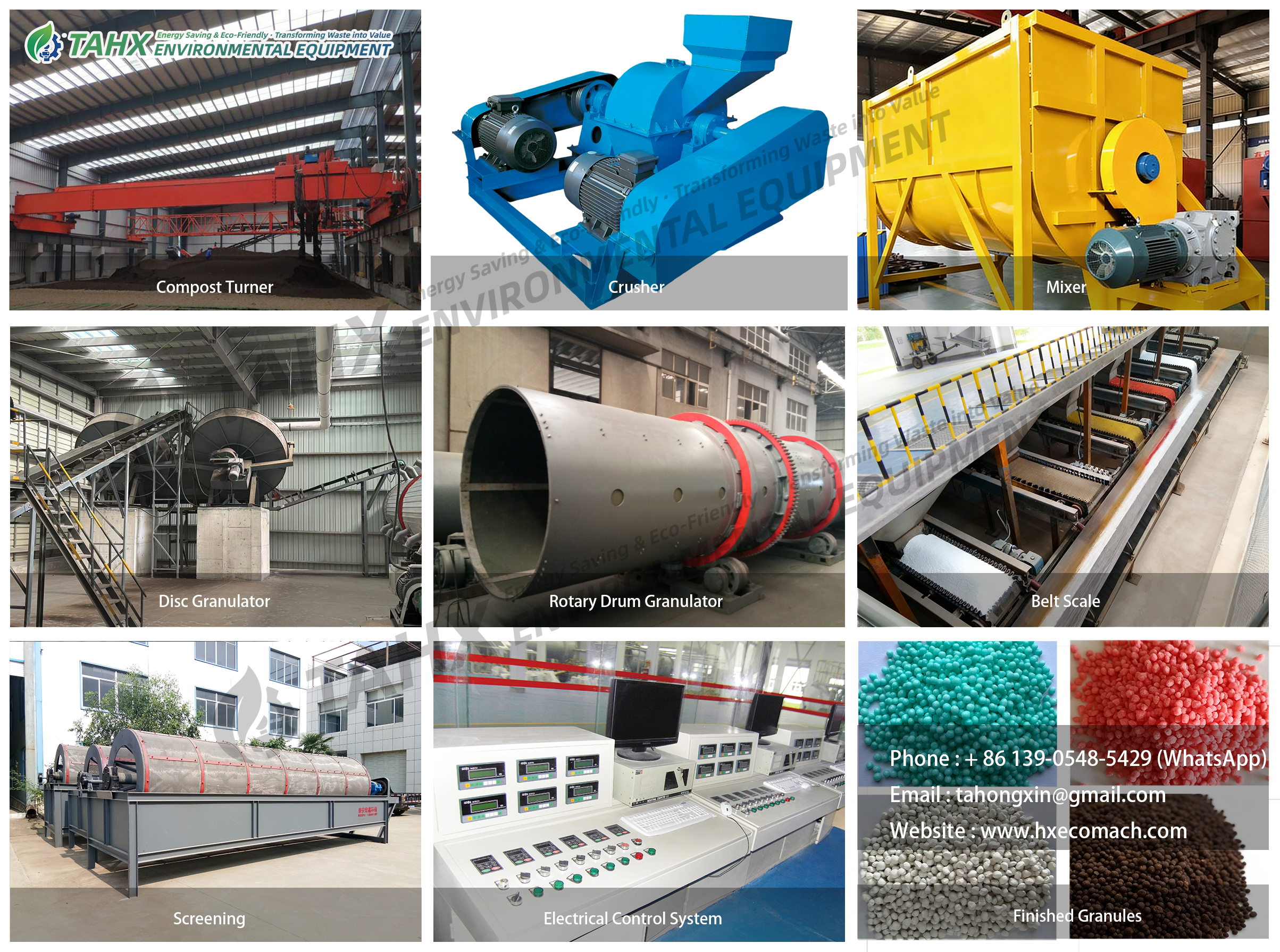
Common Equipment: Rotary drum granulators, disc granulators, and wet-type organic fertilizer granulators.
-
-
Dry Granulation Process
-
Mechanism: Relies strictly on high mechanical pressure to compress dry powder into dense sheets or pellets without liquid additives.
-
Downstream Equipment: Eliminates the need for drying burners, dryers, or coolers, drastically reducing operational energy costs.
-
Common Equipment: Double-roller extrusion granulators and flat-die/ring-die pellet mills.
-
II. Comparison of the 4 Main Granulator Types
| Granulator Type | Target Materials | Capacity Range | Core Advantages | Ideal Application |
| Rotary Drum Granulator | Compound fertilizers, NPK formulations | 5–30 t/h | Massive capacity, highly spherical pellets, excellent strength | Commercial NPK compound fertilizer lines |
| Disc (Pan) Granulator | Organic compost, general fertilizers | 0.5–3 t/h | Low initial investment, easy visual monitoring | Small-to-medium organic fertilizer plants |
| Double Roller Extruder | Dry chemical powders, thermal-sensitive feeds | 1–5 t/h | No water or drying required, low energy usage | Dry compound fertilizer & pure salt lines |
| Die Extruder (Flat/Ring) | High-fiber manure compost, pure organic waste | 1–8 t/h | Handles high-fiber feedstocks; dense cylindrical pellets | Bio-organic manure processing facilities |
III. Key Selection Factors for Fertilizer Plants
-
Raw Material Moisture & Viscosity: High-moisture (25%-40%) or fibrous organic waste favors wet drum or die extrusion granulators; dry chemical salts suit double roller granulators.
-
Production Capacity Requirements: For lower yields (<3 t/h), choose disc or flat-die granulators; for large industrial capacities (>5 t/h}$), choose rotary drum lines.
-
Energy Costs & Plant Footprint: Dry extrusion lines avoid rotary dryers and furnace installations, saving up to $40\%$ in capital expenditure and daily fuel consumption.
Tai'an Hongxin Environmental:
Supply of High-Quality and Efficient Fertilizer Production Equipment, Straw Processing Equipment, Waste Treatment Equipment and Mining Equipment. If you are looking for fertilizer production equipment and production lines, feel free to contact us at any time.- Whatsapp(Tel): + 86 139-0548-5429( Mr. Li)
- E-mail: tahongxin@gmail.com