Description
Need Factory Price or Custom Solution?
Get a instant quotation with product catalog within 24 hours.
Get A Quote Now →An advanced organic fertilizer production line plays a paramount role in the development of sustainable, green agriculture. It achieves zero-waste processing by converting organic agricultural waste into high-density, eco-friendly fertilizer pellets that can be distributed on a commercial scale.
However, many investors face unexpected technical bottlenecks during the pelletization phase. After biological fermentation, the raw compost is typically characterized by a high moisture content (30%–40%), loose bulk density ($0.3\text{--}0.4\text{ t/m}^3$), and high crude fiber content.
Part 1: Analysis of 3 Traditional Pelleting Technologies
Transforming loose, unevenly composted powder into uniform, commercial spherical pellets is the most challenging section of any organic fertilizer production line. Historically, factories have relied on three methods:
1. Pre-Drying + Flat Die / Roller Extrusion
-
The Process: Some operators first dry the raw fermented compost until the moisture level drops to 20%–25%. Then, they utilize a flat die pellet mill or roller extrusion granulator to compress the material into cylindrical or flat-ball pellets.
-
The Flaw: Although this setup is relatively simple to operate, the resulting pellets suffer from poor fluidity. They are structurally uneven, have a less appealing commercial appearance, and are completely unsuitable for precision mechanical broadcasting or seed drills.
2. Flat Die Extrusion + Centrifugal Polishing
-
The Process: This method takes high-moisture, fibrous compost and forces it through a flat die pellet mill to create short cylindrical shapes. Due to the high humidity, these pillars retain plasticity and are immediately transferred to a centrifugal pellet polishing machine to be rounded into spheres. Finally, the spheres are dried, cooled, and screened.
-
The Flaw: While this reduces pre-processing costs, it introduces fatal mechanical vulnerabilities. High-fibrous bio-manure easily causes material bridging, equipment clogging, and heavy inner-wall sticking. Furthermore, it results in low hourly output and extremely high electricity consumption per ton.
3. Traditional Rotary Drum or Disc Granulation
-
The Process: To use traditional disc or rotary drum granulators, the raw compost must first be drastically dried (moisture < 15%) and pulverized into an extremely fine powder (over 100 mesh). Operators must then add heavy binders and inorganic chemical fertilizers (NPK), ensuring the chemical additives do not exceed 30% of the total formula weight.
-
The Flaw: This cycle—de-watering, crushing, re-wetting for granulation, and re-drying—creates a massive thermal and mechanical repetition that skyrockets processing costs. Moreover, because organic matter has low natural density, the resulting pellets exhibit low crushing strength, making them fragile during bulk storage, shipping, and mechanical field application.
Part 2: The Modern Solution for High-Yield Fertilizer Plants
To solve these persistent industry headaches, a modern, commercial-scale organic fertilizer production line requires high-capacity, low-energy, and clog-resistant compression granulation equipment.
A high-performance organic fertilizer production line configured by TAHX perfectly eliminates the problems of material bridging, clogging, and component sticking. By optimizing the mechanical torque and introducing specialized wear-resistant alloy coatings, our complete setups deliver high hourly output, high granule density, and significantly reduced power consumption.
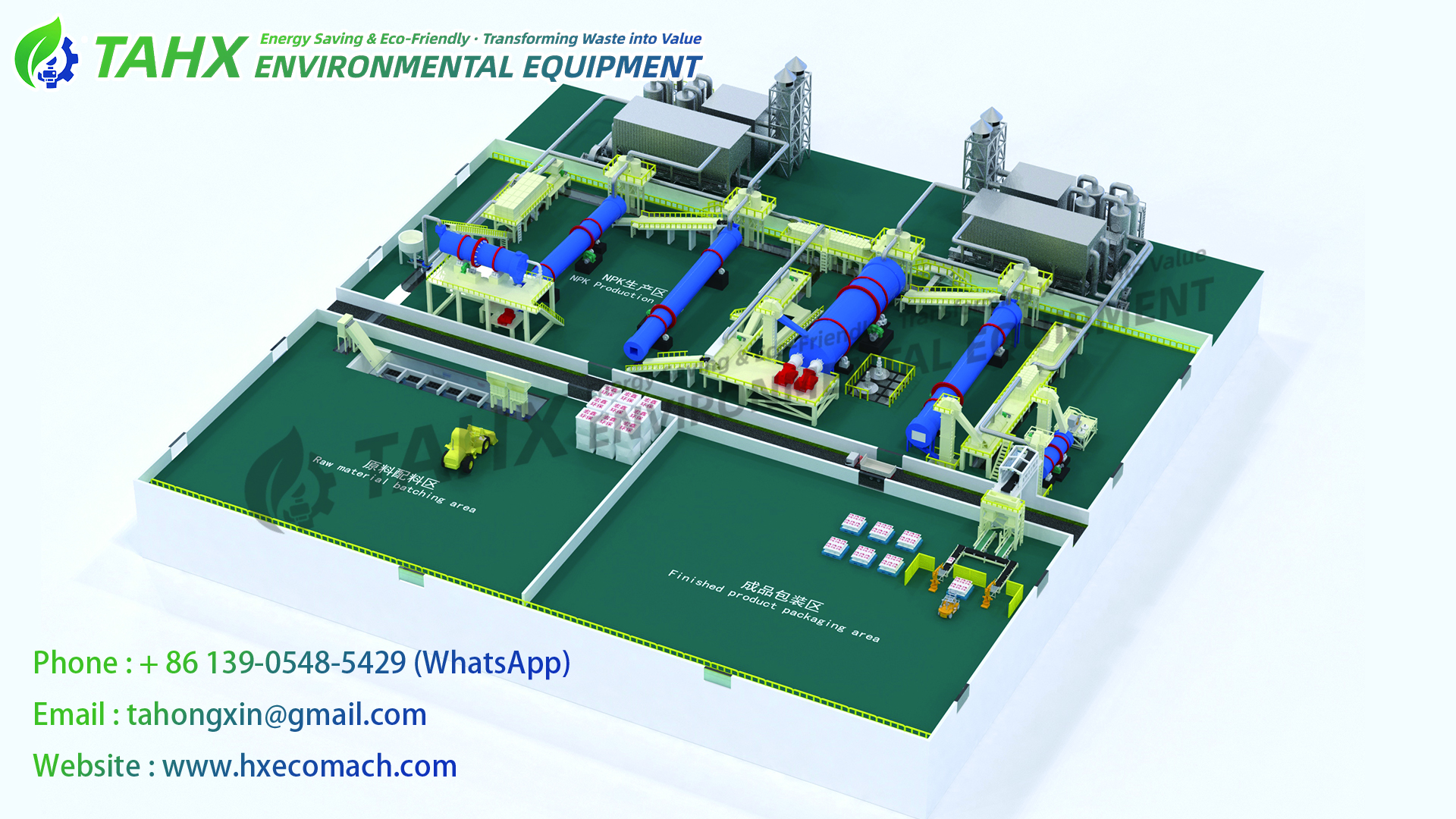
Tai'an Hongxin Environmental Equipment
Reliable Manufacturer of High-Quality Fertilizer Production & Waste Treatment Lines.
Tai'an Hongxin Environmental Equipment:
Supply of High-Quality and Efficient Fertilizer Production Equipment, Straw Processing Equipment, Waste Treatment Equipment and Mining Equipment. If you are looking for fertilizer production equipment and production lines, feel free to contact us at any time.- Whatsapp(Tel): + 86 139-0548-5429( Mr. Li)
- E-mail: tahongxin@gmail.com